- TheTip.AI - AI for Business Newsletter
- Posts
- Amazon replaces Rufus with Alexa for Shopping
Amazon replaces Rufus with Alexa for Shopping

Jeff J Hunter
May 14, 2026
Is conversational shopping the new default on Amazon?
Hi ,
Amazon just retired Rufus and launched something significantly more capable.
Called Alexa for Shopping. Powered by Alexa+. Live now for U.S. customers.
Answers questions about your purchase history. Compares products. Tracks prices. Schedules recurring orders. And can shop other online retailers and buy on your behalf.
AI just took over the Amazon search bar.
Today's prompt builds a tiered service comparison that makes choosing easy and upgrades obvious. Tips and Tricks Thursday covers how to turn your existing project work into a portfolio that sells while you sleep. Then the full breakdown on what Amazon just launched.
🔥 Prompt of the Day 🔥
Service Tier Comparison Builder: Use ChatGPT or Claude
Create one decision-simplifying package layout.
"Act as a pricing page specialist. Create one tiered service comparison for [SERVICE BUSINESS] that guides buyers toward the right package.
Essential Details:
Number of Tiers: [2/3/4]
Core Service: [WHAT ALL TIERS INCLUDE]
Key Differentiators: [WHAT SEPARATES EACH]
Ideal Tier: [WHICH YOU WANT MOST SOLD]
Price Range: [LOW TO HIGH]
Anchor Strategy: [HOW TO FRAME VALUE]
Create one tier comparison including:
Tier names that communicate value
Feature breakdown per level
Visual emphasis on recommended tier
Clear upgrade justification
FAQ addressing 'which is right for me'
CTA copy per tier
Make choosing easy and upgrades obvious."
Variables:
SERVICE BUSINESS: What kind of service you offer
NUMBER OF TIERS: How many packages you want
WHAT ALL TIERS INCLUDE: The core service every tier gets
WHAT SEPARATES EACH: The key differences between levels
WHICH YOU WANT MOST SOLD: Your target tier
HOW TO FRAME VALUE: Your anchoring strategy
Why This Works:
Confused buyers don't buy. AI builds the comparison that removes confusion and guides the decision. Tier names that communicate value. A recommended tier that stands out visually. Upgrade justifications that make the next level feel obvious. A FAQ that handles objections before they slow the sale. The right packaging sells more than the right price.
✅ Tips and Tricks Thursday ✅
Portfolio Case Study Generator
Freelancers and agencies do great work and never document it.
Most portfolios are thin, outdated, or missing entirely because writing case studies feels like homework on top of real work.
Everything you need is already sitting in your inbox and project folders.
The Problem
You finish a client project. Results are strong. You move on.
Six months later you're pitching a new client and scrambling to remember what you did, what the outcome was, and how to frame it compellingly.
The work happened. The proof just never got captured.
Why Case Studies Close Deals
A good proposal tells a prospect what you'll do.
A good case study shows a prospect what you've already done for someone exactly like them.
The second one is significantly more persuasive. Every time.
What You Already Have
The project brief or scope of work. The client emails describing the problem. The results data — traffic numbers, revenue figures, time saved, leads generated.
That's a case study. It just hasn't been structured yet.
How To Build It With AI
Paste the project brief, relevant client emails, and results data into Claude or ChatGPT.
Use this prompt: "Structure this into a case study with three sections — situation, approach, result. Highlight the specific problem solved and the measurable outcome. Then generate three headline options that lead with the result."
What comes back is a publishable case study draft that took you five minutes instead of two hours.
The Three Sections That Matter
Situation — what was the client's problem before you got involved. Be specific. Generic problems don't resonate.
Approach — what you actually did. Not a list of services. A description of the thinking and the work.
Result — the measurable outcome. Numbers where possible. Client quotes where you have them. Specificity beats vague success claims every time.
The Habit That Builds The Portfolio
One case study per month. Non-negotiable.
Pick a recently completed project at the end of each month. Spend 30 minutes pulling the brief, emails, and results together. Feed it to AI. Edit the output. Publish.
Twelve months from now you have twelve case studies covering different industries, problems, and outcomes. That portfolio closes clients while you're asleep.
What To Do
Open your last completed project folder right now.
Find the brief, a few client emails, and whatever results you tracked.
Paste them into Claude or ChatGPT with the prompt above.
Edit the output for accuracy and tone. Publish to your website or portfolio page.
Set a monthly reminder to repeat.
Strong portfolios sell while you sleep.
Did You Know?
The number of scientific papers listing an AI system as a co-author has increased dramatically — sparking heated debate in academic journals about whether a tool that cannot take responsibility for errors, defend its reasoning, or consent to publication should ever receive authorship credit.
🗞️ Breaking News 🗞️
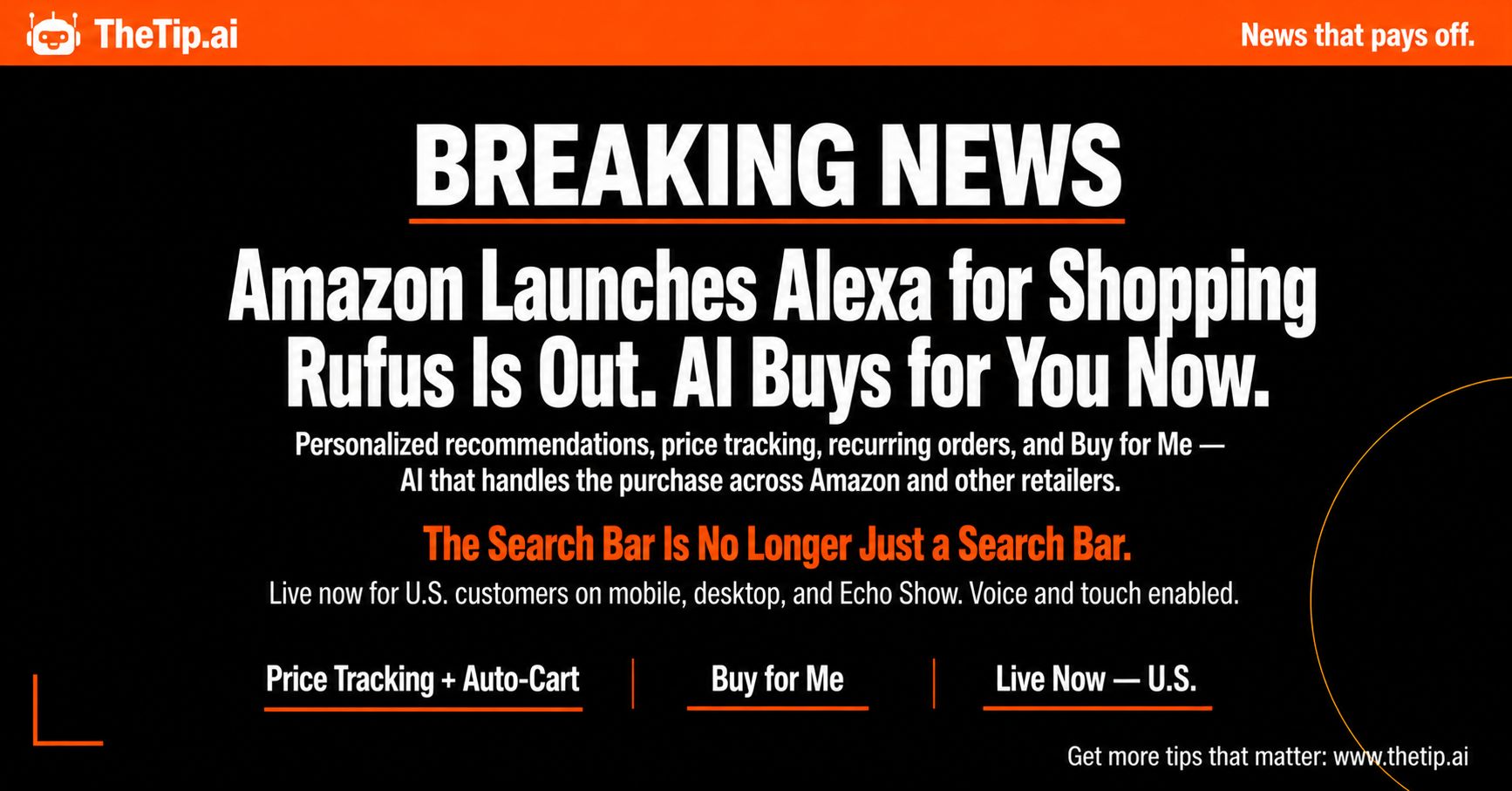
Amazon Launches Alexa for Shopping — Replacing Rufus With a Fully Personalized AI Shopping Assistant
Amazon just upgraded how you shop on their platform.
Rufus is out. Alexa for Shopping is in.
Live now for U.S. customers across mobile, desktop, and Echo Show smart displays. Voice and touch enabled.
What Rufus Did vs What Alexa for Shopping Does
Rufus focused on product discovery and comparison. A smarter search experience.
Alexa for Shopping goes further. Personalized recommendations based on your habits, preferences, and purchase history. Automation of the shopping experience across Amazon and other online retailers.
The difference is meaningful. Rufus helped you find things. Alexa for Shopping helps you buy things — including handling the purchase itself.
What It Can Do
Answer questions about your purchase history — "When did I last order AA batteries?"
Answer lifestyle questions — "What's a good skincare routine for men?" — and surface relevant products tied to the answer.
Compare products side by side. Track prices over time. Schedule recurring orders for essentials like pet food or paper towels.
Set conditional cart additions — "Add this sunscreen to my cart if the price drops to $10." Alexa monitors and acts automatically.
Shop beyond Amazon. The Buy for Me feature lets Alexa shop other online retailers and handle the purchase on your behalf.
Why Buy for Me Is Controversial
AI buying from third-party retailers on your behalf has already drawn backlash from online sellers.
The concern is straightforward. If Alexa is choosing which retailer to buy from, Amazon controls the decision — and smaller retailers competing with Amazon's own listings have good reason to worry about how that choice gets made.
Amazon has not fully addressed those concerns publicly.
The Broader Amazon AI Push
Alexa for Shopping arrives alongside two other recent Amazon AI launches.
Amazon Now — 30-minute delivery service now expanding across dozens of U.S. cities.
AI-powered audio Q&A — real-time conversational audio responses to product questions on product pages.
Amazon is building AI into every stage of the shopping journey. Discovery. Purchase. Delivery. Customer questions.
Why This Matters
Shopping is one of the highest-frequency consumer behaviors.
Amazon embedding a personalized AI assistant into the search bar — the entry point for every shopping session — gives Alexa access to the most valuable moment in the commerce journey.
For shoppers: A genuinely useful assistant that knows your history, tracks prices, and handles the logistics of buying.
For retailers on Amazon: A powerful distribution advantage that also means Amazon's AI is now the intermediary between your product and the buyer.
For the commerce market: Conversational AI shopping is moving from experiment to default experience on the world's largest retail platform.
What This Means
If you shop on Amazon regularly, Alexa for Shopping is live now. Worth testing how it handles your recurring purchases and price tracking.
If you sell on Amazon, the AI assistant recommending products based on purchase history and habits is now part of the competitive landscape you're operating in.
If you watch commerce trends, Amazon just made AI the default starting point for every shopping session on their platform.
The search bar is no longer just a search bar.
Over to You...
Amazon just made AI the first thing you interact with when you shop.
Does that make your experience better or just more automated?
Send me your thoughts.
To shopping that works for you,
Jeff J. Hunter
Founder, AI Persona Method | TheTip.ai
P.S. Want to turn AI Agents into a consulting offer? Book your AI Certified Consultant strategy 👉 here.
 | » NEW: Join the AI Money Group « 🚀 Zero to Product Masterclass - Watch us build a sellable AI product LIVE, then do it yourself 📞 Monthly Group Calls - Live training, Q&A, and strategy sessions with Jeff |
Sent to: {{email}} Jeff J Hunter, 3220 W Monte Vista Ave #105, Turlock, Don't want future emails? |
Reply