- TheTip.AI - AI for Business Newsletter
- Posts
- Build virtual experiences without coding knowledge
Build virtual experiences without coding knowledge

Jeff J Hunter
January 30, 2026
Skip expensive 3D development
Hi ,
You can now generate entire worlds with AI.
Google's Project Genie turns text prompts into interactive environments you can walk through, fly over, or drive across.
The world generates in real-time as you move. No 3D modeling. No game engines. Just describe what you want.
Available now to Google AI Ultra subscribers in the U.S.
World models just became consumer products.
Here's today's authority-building content framework and a look at where this takes online retail over the next few years...
🔥 Prompt of the Day 🔥
The Authority Builder: Use ChatGPT or Claude
Act as a world-class B2B content strategist and thought-leadership expert specializing in educational nurture programs.
You are helping a company educate and nurture prospects experiencing real problems. The goal is to build authority and trust over time while moving them from problem awareness to solution consideration.
Essential Details:
Industry: [YOUR INDUSTRY]
Target Persona: [WHO YOU'RE EDUCATING]
Primary Pain Points: [WHAT THEY'RE STRUGGLING WITH]
Solution Type: [WHAT YOU OFFER]
Core Topic: [MAIN SUBJECT AREA]
Content Goal: [AWARENESS/CONSIDERATION/DECISION]
Create one educational content plan including:
Top questions this persona asks (what they're searching for)
Common misconceptions (what they believe that's wrong)
Hidden challenges (problems they don't know they have)
3-5 blog or article ideas (demonstrate expertise without pitching)
Content progression (how topics build on each other)
Trust-building elements (what proves you understand them)
Build authority through education, not promotion.
🔮 Future Friday 🔮
AI Simulates Your Entire Business Before You Launch It
Starting a business is expensive and risky.
Most fail within two years. You learn what doesn't work after spending real money.
By 2027-2028, that changes completely.
AI will simulate your entire business before you launch. Not a business plan. A running simulation.
AI customers. AI employees. AI competitors. AI market conditions.
You run your business for simulated months or years. See what breaks. Test pricing. Try strategies. Watch it succeed or fail.
All before spending real money.
What Business Simulation Actually Means
World models simulate how systems behave over time.
Apply this to business: You operate a simulated version of your company.
Describe your business model. AI generates the complete operating environment. Then you run it.
Make decisions. Respond to problems. Compete. Grow or fail.
The simulation tracks everything: cash flow, customer behavior, employee performance, competitor moves, market shifts.
You iterate until you find what works. Then launch in reality with a tested playbook.
Why This Changes Everything
Right now, you learn by failing in real markets with real money.
Launch a product nobody wants. Hire the wrong team. Price incorrectly. Run out of cash.
Each mistake costs thousands or millions.
Business simulation removes that cost.
Test ten pricing strategies in simulation. See which converts best. Launch with the winner.
Try three hiring approaches. Watch which team structure performs. Build that team in reality.
Experiment with marketing channels. Identify what drives growth before spending ad budget.
The Timeline
2026: Early simulation tools launch for simple models. E-commerce and SaaS get basic simulations. Limitations: Short time horizons, simplified variables.
2027: Simulation quality reaches usefulness. AI accurately models customer acquisition, retention, lifetime value. Competitors' responses get simulated. Time horizons extend to 6-12 months.
2027-2028: Investors start requiring simulation results before funding. Business schools integrate simulation into curriculum. Failure rates drop as founders launch with tested models.
2028-2029: Complex businesses get accurate simulations. Running simulations before launching becomes standard practice.
A Real Scenario
An entrepreneur wants to launch a subscription box business.
Old way:
Write business plan with guessed projections Launch and discover acquisition costs are 3× higher than expected Run out of money in 6 months
New way with simulation:
Describe business to AI: "Subscription box. Sustainable home products. $45/month. Target: eco-conscious millennials."
AI generates complete simulation with virtual customers, competitors, supply chain, ad platforms.
Run for 12 simulated months: Test pricing at $35, $45, $55. Try different acquisition channels. Adjust product mix.
Simulation shows: $45 works with specific Instagram targeting. Adding quarterly surprise products reduces churn. Need $80K runway to reach profitability month 9.
Launch in reality with tested pricing, proven channel, and accurate funding needs.
Result: Business survives because founder already solved critical problems in simulation.
What Gets Disrupted
Business consulting gets replaced by AI simulation showing what works.
Traditional business plans get replaced by dynamic simulations.
Market research firms lose to AI-generated customer behavior data.
Early-stage failure rates drop as founders test first.
What Survives
Execution capability: Simulation shows what works. You still have to do it.
Creative vision: Simulation tests ideas. It doesn't generate them.
Adaptability: Real markets throw unexpected curveballs.
Sales skills: Knowing what works doesn't mean you can deliver it.
The Risks
Over-reliance: Founders trust the model too much and ignore real market signals.
Accuracy limitations: Early versions won't capture every variable.
False confidence: Succeeding in simulation doesn't guarantee real success.
Data requirements: Novel business models without comparable data get less reliable simulations.
What This Means
If you're launching in 2027-2028, expect investors to ask: "Did you simulate this?"
If you're in established categories, simulation tools will exist. Use them before spending money.
If you're creating something completely new, simulations will be less accurate but still useful for testing basic assumptions.
The entrepreneurs who win will be the ones who practice in simulation before competing in reality.
Did You Know?
AI studying dust patterns in homes can determine residents' daily routines, health status, and even relationship dynamics with startling accuracy.
🗞️ Breaking AI News 🗞️
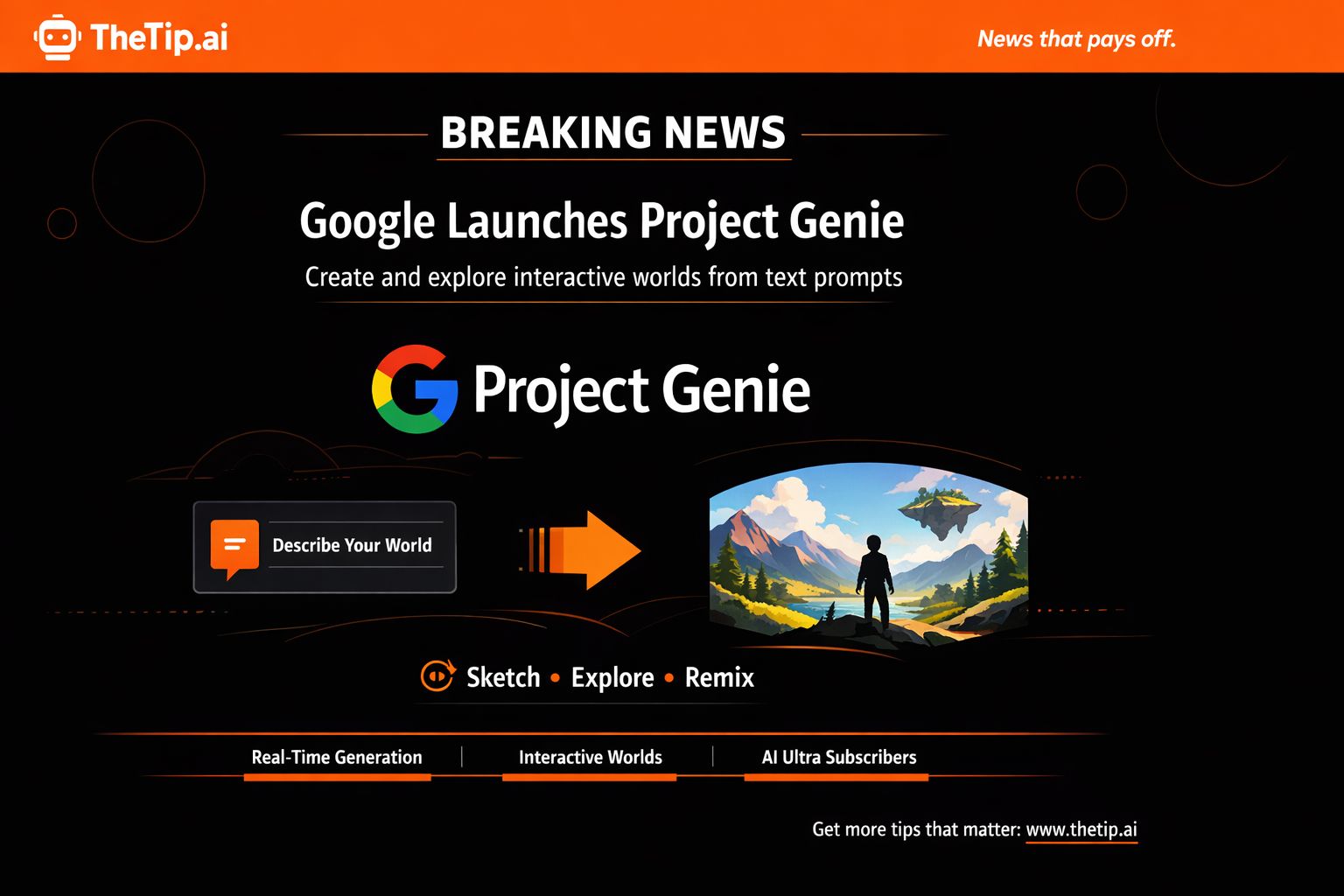
Google Launches Project Genie for Interactive World Creation
Google announced Project Genie, an experimental research prototype that lets users create, explore, and remix interactive worlds.
Rolling out to Google AI Ultra subscribers in the U.S.
What Changed
Project Genie is a web app powered by Genie 3, Nano Banana Pro, and Gemini.
It turns text prompts and images into explorable, interactive environments.
You describe what you want. The AI generates a living world. You explore it in real-time as it generates the path ahead based on your actions.
The Three Core Capabilities
World Sketching: Prompt with text and generated or uploaded images to create environments. Create your character and world. Define how you explore it—walking, riding, flying, driving.
Nano Banana Pro integration lets you preview what your world will look like and modify images to fine-tune before jumping in. You define your perspective (first-person or third-person) before entering.
World Exploration: Your world is a navigable environment. As you move, Project Genie generates the path ahead in real-time based on your actions. You can adjust the camera as you traverse.
World Remixing: Remix existing worlds into new interpretations by building on their prompts. Explore curated worlds in the gallery or randomizer for inspiration. Download videos of your worlds and explorations.
How It Works
Genie 3 is a world model that simulates environment dynamics.
It predicts how environments evolve and how actions affect them.
Unlike static 3D snapshots, Genie 3 generates paths in real-time as you move and interact.
It simulates physics and interactions for dynamic worlds. Its consistency enables simulation of any real-world scenario—from robotics and animation to exploring locations and historical settings.
Real Use Cases
Exploring historical settings: Walk through ancient civilizations or historical events.
Testing robotics scenarios: Simulate real-world environments for robot training.
Animation and fiction: Create worlds for storytelling without building 3D assets manually.
Location exploration: Experience places you can't physically visit.
Known Limitations
Generated worlds might not look completely true-to-life or always adhere closely to prompts, images, or real-world physics.
Characters can sometimes be less controllable or experience higher latency in control.
Generations limited to 60 seconds currently.
Some Genie 3 capabilities announced in August, like promptable events that change the world as you explore, aren't yet included in this prototype.
The Technical Context
World models are critical for building AGI.
Google DeepMind has built agents for specific environments like Chess or Go. But building AGI requires systems that navigate the diversity of the real world.
Genie 3 meets this challenge by generating diverse, interactive environments from simple prompts.
Availability
Access begins rolling out today to Google AI Ultra subscribers in the U.S. (18+).
Expanding to more territories in due course.
Google's goal is to make these experiences and technology accessible to more users over time.
Why This Matters
This is the first consumer-accessible world generation model.
Previously, creating interactive 3D environments required game engines, 3D modeling skills, and coding knowledge.
Project Genie removes those barriers. You describe what you want. AI builds it.
For game developers, this represents a fundamental shift in how interactive experiences get created.
For educators, this enables creating custom learning environments without technical expertise.
For businesses, this opens possibilities for virtual showrooms, training simulations, and product demonstrations.
The technology is early. 60-second generation limits and inconsistent physics show it's not production-ready yet.
But the direction is clear: Interactive world creation becomes accessible to anyone who can describe what they want.
What This Means
If you're building interactive experiences, expect world models to replace traditional 3D development workflows for certain use cases by 2027-2028.
If you're in game development, this technology will disrupt how exploration and narrative games get made.
If you're in e-commerce, virtual storefronts generated from prompts become realistic within two years.
If you're evaluating AI capabilities, world models represent the next major leap after text and image generation.
Project Genie is Google's bet that creating explorable worlds becomes as common as generating images.
Over to You...
What's the first interactive world you'd create if you had access to Project Genie right now?
Hit reply and tell me what you'd build.
To AI-generated worlds,
Jeff J. Hunter
Founder, AI Persona Method | TheTip.ai
 | » NEW: Join the AI Money Group « 🚀 Zero to Product Masterclass - Watch us build a sellable AI product LIVE, then do it yourself 📞 Monthly Group Calls - Live training, Q&A, and strategy sessions with Jeff |
Sent to: {{email}} Jeff J Hunter, 3220 W Monte Vista Ave #105, Turlock, Don't want future emails? |
Reply