- TheTip.AI - AI for Business Newsletter
- Posts
- Google Labs announces Vibe Design with new Stitch
Google Labs announces Vibe Design with new Stitch

Jeff J Hunter
March 20, 2026
Wireframes officially dead now?
Hi ,
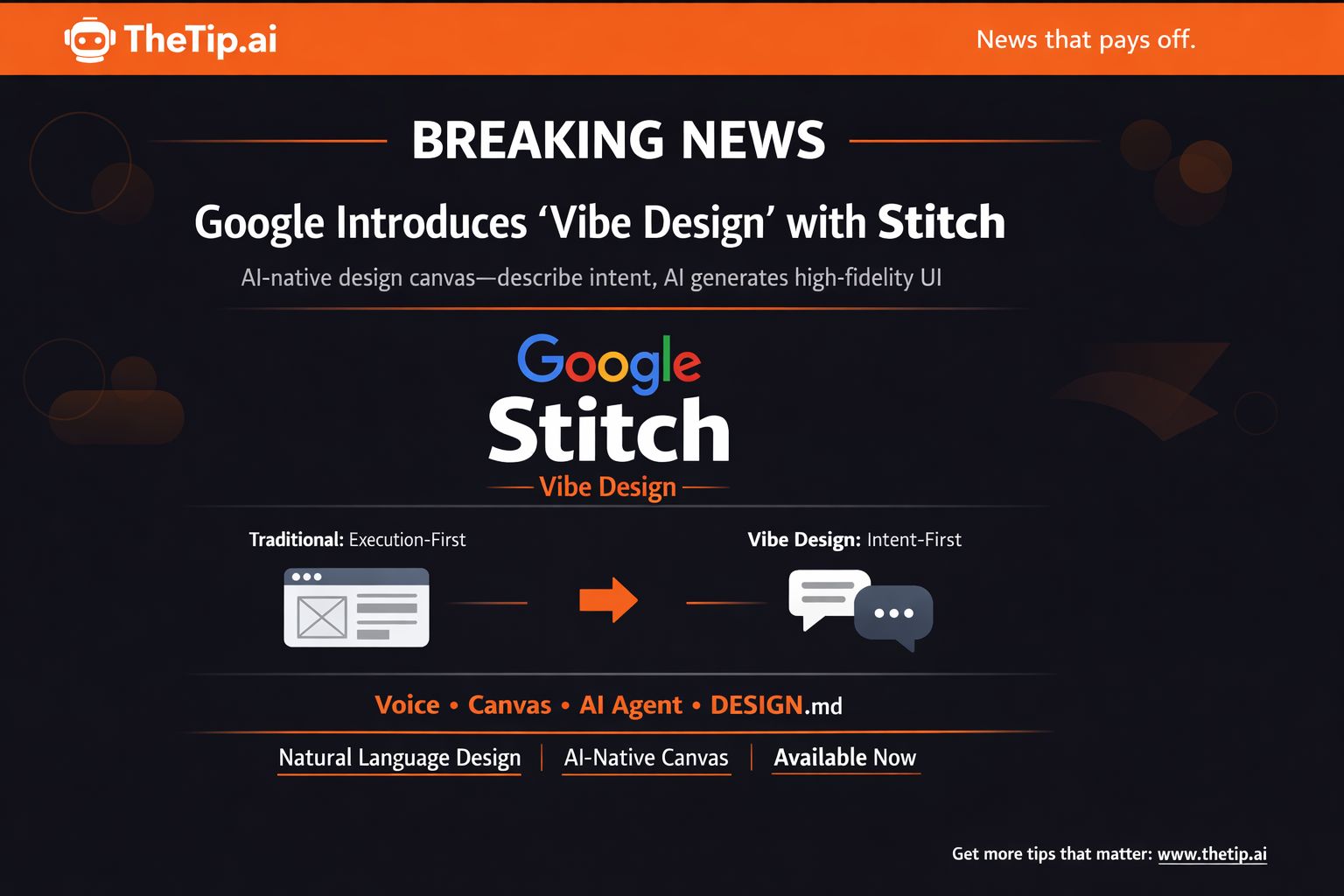
Google just launched "vibe design" with Stitch.
AI-native software design canvas. Natural language creates high-fidelity UI designs.
Explain business objective. What you want users to feel. AI generates interactive prototypes.
Voice capabilities. Speak directly to canvas. Real-time design critiques and updates.
Infinite canvas. Design agent that reasons across entire project. DESIGN.md for exporting design systems.
Available now in Google Labs.
Today's psychological reactance framework stops customer pushback before it starts. Why AI skills training becomes public infrastructure like libraries by 2027. After that, how Google turned conversation into production-ready UI.
🔥 Prompt of the Day 🔥
Psychological Reactance Marketing Shield: Use ChatGPT or Claude
Create one resistance-prevention framework.
The Prompt:
"Act as a psychological marketing strategist.
Create one framework for [PERSUASIVE CAMPAIGN] that prevents psychological reactance and customer pushback.
Essential Details:
Campaign Intensity: [SOFT/MODERATE/AGGRESSIVE]
Target Resistance Level: [LOW/HIGH REACTANCE PERSONALITY]
Message Frequency: [TOUCH POINTS]
Freedom Threat Perception: [CHOICE LIMITATION]
Authority Positioning: [EXPERT/PEER/CELEBRITY]
Compliance Goal: [DESIRED ACTION]
Create one reactance prevention system including:
Freedom restoration opportunity integration
Choice architecture design
Indirect influence pathway mapping
Authority gradient optimization
Reactance early warning signals
Persuasion approach recalibration
Persuade without triggering resistance."
Variables:
PERSUASIVE CAMPAIGN: What you're promoting
CAMPAIGN INTENSITY: How aggressive
TARGET RESISTANCE LEVEL: Audience reactance personality
MESSAGE FREQUENCY: How many touchpoints
AUTHORITY POSITIONING: Who delivers message
Why This Works:
People resist when they feel forced. Psychological reactance is automatic pushback against perceived threats to freedom. This framework designs persuasion that feels like choice, not pressure.
🔮 Future Friday 🔮
I Skills Training Becomes Localized Infrastructure by 2027
AI training stops being courses you take.
Becomes infrastructure your community provides.
Like libraries. Like schools. Like public transit.
Local. Contextualized. Free or low-cost. Sustained.
Why This Happens
Google.org just reported 5 years of digital upskilling results.
$150 million. 70 organizations. 41 countries. Millions reached.
Four lessons emerged:
Context matters. One-size-fits-all fails.
Growth mindset beats specific skills. Tech changes. Adaptability lasts.
Long-term infrastructure beats one-time programs.
System-level change scales. Individual programs don't.
Those lessons predict where AI training goes.
How It Works 2027
Your city launches AI Skills Commons.
Not online course. Physical space. Local instructors. Wraparound support.
Help with living costs while learning. Technology access. Language support. Childcare.
Curriculum adapts to local economy. Your city needs healthcare workers? AI training focuses there. Manufacturing hub? Different focus.
Alumni become instructors. Self-sustaining cycle. Community teaching community.
Not vendor-dependent. Open models. Local control. Survives tech company pivots.
The Evidence
Ukraine's Diia.Osvita platform: Started local digital project. Now national infrastructure. Serves 52% of adults.
Czechitas: Alumni make up 40% of educator community. Self-sustaining.
Programs with wraparound support: 44% completion rate. Double the rate without support.
TSL's SkillPlus: 69% of learners continued developing skills after program ended. Growth mindset lasted.
What Changes 2027
AI training becomes utility. Not luxury. Not optional course.
Funded like infrastructure. Not dependent on corporate grants that end.
Governments budget for AI skills like they budget for roads. Essential infrastructure for economic participation.
Localized to community needs. Not generic "learn AI" curriculum.
Healthcare community trains AI for patient care. Manufacturing trains AI for quality control. Retail trains AI for inventory optimization.
Context-specific. Not universal.
Free or low-cost access standard. Means-tested support for living costs while training.
Nobody excluded because they can't afford to not work while learning.
Why 2027
AI skills gap widening. Generic courses not closing it.
Communities realize one-size-fits-all training fails. Local needs differ.
Governments see AI skills as infrastructure investment. Not individual responsibility.
Wraparound support models proven. Data shows they work. Scale them.
Did You Know?
TIME Magazine named the "Architects of AI" its Person of the Year, recognizing figures like NVIDIA's Jensen Huang and others who have driven the technology from a research curiosity into a force reshaping industries, economies, and daily life worldwide.
🗞️ Breaking AI News 🗞️
Google Introduces "Vibe Design" with Stitch
Google announced evolution of Stitch into AI-native software design canvas.
Allows anyone to create, iterate, and collaborate to turn natural language into high-fidelity UI designs.
VP Google Labs Josh Woodward: "AI can be a creativity multiplier, helping people explore many ideas quickly."
What Vibe Design Means
When "vibe designing" in Stitch, you explore many ideas quickly leading to higher quality outcome.
Instead of starting with wireframe, start by explaining business objective you're hoping to achieve. What you want users to feel. Examples of what's currently inspiring you.
Not execution-first. Intent-first.
New AI-Native Canvas
Complete redesign of Stitch UI.
Features new AI-native, infinite canvas. Gives ideas room to grow from early ideations to working prototypes.
Built to amplify creativity throughout design process. Where you often diverge and converge before landing on something great.
Allows you to bring ideas regardless of shape they take. Images. Text. Even code. Directly to canvas as context.
New Design Agent
Canvas's extensive context paired with brand new design agent.
Can reason across entire project's evolution.
When you want to explore more directions, new Agent manager tracks progress. Helps work on multiple ideas in parallel while staying organized.
Design Systems with DESIGN.md
Broadened design system toolkit to enable creation with deeper context.
Can easily extract design system from any URL.
Or use new DESIGN.md. Agent-friendly markdown file. Export or import design rules to or from other design and coding tools.
Apply designs to different Stitch project. Don't reinvent wheel every time you start.
Interactive Prototypes Instantly
Design is process of constant refinement. Being able to test ideas in real-time crucial to maintaining creative momentum.
Transforms static designs into interactive prototypes instantly.
Experience user journey immediately.
"Stitch" screens together in seconds. Simply click "Play" to quickly preview interactive app flow.
Stitch can automatically generate logical next screens based on click. Maps out user journeys effortlessly.
Rapid feedback loop. Refine individual elements or overhaul entire flows with single click.
Voice Capabilities
Introducing voice capabilities. Speak directly to your canvas.
Agent can give real-time design critiques. Design new landing page by interviewing you. Make real-time updates.
"Give me three different menu options."
"Show me this screen in different color palettes."
As you speak, AI updates.
Acts as sounding board. Helps uncover top ideas through dynamic critique and dialogue. Ensures you remain in creative flow.
Integration with Developer Tools
Stitch can act as bridge to all other tools in team's workflow.
Using recently released Stitch MCP server and SDK, can leverage Stitch's capabilities via skills and tools.
Export designs to developer tools like AI Studio and Antigravity.
Ensures partnership between you, AI, and developers remains seamless and synchronized.
Availability
Available now in Google Labs.
Why This Matters
Google positioning Stitch as AI-native design tool. Not retrofitting AI into existing tool.
Built from ground up for natural language design.
For designers: Tool that starts with intent, not execution. Describe what you want. AI generates it.
For Google: Competing with Figma, Adobe, Canva by offering fundamentally different approach. Conversation over clicking.
For design industry: Validates shift toward natural language interfaces. Not just AI features. AI-native workflows.
What This Means
If you're designer: Vibe design available now. Test describing intent instead of manually designing.
If you're Figma or Adobe: Google competing on different paradigm. Natural language native, not feature addition.
If you're building products: Design process accelerating dramatically. Intent to prototype in minutes, not days.
Design tools becoming conversational. Not just visual editors with AI assist.
Over to You...
What would you design differently if explaining intent generated high-fidelity UI instead of clicking for hours?
Let me know what becomes possible.
To intent-first design,
Jeff J. Hunter
Founder, AI Persona Method | TheTip.ai
P.S. Want to turn AI Agents into a consulting offer? Book your AI Certified Consultant strategy 👉 here.
 | » NEW: Join the AI Money Group « 🚀 Zero to Product Masterclass - Watch us build a sellable AI product LIVE, then do it yourself 📞 Monthly Group Calls - Live training, Q&A, and strategy sessions with Jeff |
Sent to: {{email}} Jeff J Hunter, 3220 W Monte Vista Ave #105, Turlock, Don't want future emails? |
Reply