- TheTip.AI - AI for Business Newsletter
- Posts
- Google's AI Mode scans your inbox and photo albums for customized results
Google's AI Mode scans your inbox and photo albums for customized results

Jeff J Hunter
January 23, 2026
Save hours on research
Hi ,
Google just launched Personal Intelligence in Search.
AI Mode now connects to your Gmail and Photos. It pulls context from your actual life not generic web results.
You ask about restaurants. It remembers your trip photos and suggests places near your hotel.
You search for coats. It checks your flight details and recommends options for the weather you're heading into.
This is Google's move on personal context as the next AI battleground.
But first, today's content strategy prompt and future forecast (then see what Personal Intelligence means for AI...)
🔥 Prompt of the Day 🔥
The Content Synergist
Save massive time by creating content that works for two brands simultaneously without confusing audiences.
Act as a Content Strategy Director.
I have two brands: [BRAND 1] and [BRAND 2]. They have overlapping audiences but distinct goals. Creating content for both feels overwhelming.
Design a Synergistic Content Calendar strategy. Show me how to create one core piece of pillar content on [TOPIC] that can be slightly tweaked or repurposed to serve both brands effectively.
Provide 5 concrete examples of how one idea can be split into two distinct posts that serve the specific goals of each brand without looking like duplicates.
Turn one content piece into two brand-specific assets.
🔮 Future Friday 🔮
Agentic AI Takes Over This Year
AI is about to stop being a tool you use.
It's becoming the system that runs your operations autonomously.
Mark Minevich, an AI strategist, just published 11 predictions for this year showing how dramatically work is about to change.
This year marks the shift. AI isn't a layer you add to systems anymore. It's becoming the infrastructure itself.
Every Employee Gets a Dedicated AI Assistant
Not a chatbot that answers questions. An always-on teammate that handles tasks across your entire IT infrastructure.
HR onboarding. Training. Compliance. Benefits questions. Policy interpretation. Performance guidance. Meeting scheduling. Forecasting. Inventory management. Communications.
Gartner predicts 40% of enterprise applications will embed task-specific AI agents by end of this year.
These aren't assistants that provide suggestions. They're workflow partners that take action autonomously.
Hiring and Advancement Change Completely
Advancement in 2026 depends on AI literacy, not traditional credentials.
Forrester predicts 30% of large enterprises will mandate AI fluency training this year.
Job interviews shift from "Tell me about yourself" to "Show me how you'd orchestrate three AI agents to automate this 12-step process."
HR teams evolve from administrators to strategic architects of AI-augmented human performance.
The employees with the best chance at growth and advancement will be the ones who embrace AI, learn to use it effectively, and work with the technology best.
But there's a catch: Gartner warns that overreliance on AI may atrophy critical-thinking skills. 50% of organizations will require "AI-free" skills assessments in hiring and promotions this year.
Humanoid Robots Enter Production
Physical AI moves from demonstrations to commercial pilots in warehouses and factories this year.
Tesla, Figure, and Agility are aiming for thousands to tens of thousands of units deployed.
Manufacturing faces structural skilled labor shortages. Pipe fitters, technicians, experienced operators—all in short supply globally.
AI augments skilled workers by automating repetitive tasks, improving safety outcomes, optimizing supply chains, and personalizing training at scale.
Companies that embrace AI-driven productivity will dominate production and cost efficiency. Those that don't will fall behind fast.
Multi-Agent Systems Replace Single Agents
Single AI agents evolve into orchestrated multi-agent systems this year.
Dozens or hundreds of specialized agents collaborate on complex, long-running tasks: supply chain optimization, R&D pipelines, patient care journeys.
One agent monitors inventory. Another predicts demand. A third identifies disruptions. A fourth reroutes shipments. A fifth adjusts production schedules. A sixth allocates maintenance resources. All coordinating automatically without human management.
Manufacturing example: Component shortage detected. Alternative suppliers identified and quality verified automatically. Pricing negotiated. Existing inventory rerouted. Production schedules adjusted. Manager gets notification: "Disruption resolved."
The system executed everything before the manager even knew there was a problem.
Voice Becomes Prime Advertising Real Estate
People are speaking their questions instead of typing them.
"Find me a dentist." "Compare mortgage rates." "Recommend an accountant near me."
Voice queries reveal high-intent, real-time needs better than search history ever did.
This year, voice becomes the most valuable signal in contextual advertising targeting.
Brands that master conversational interfaces will dominate. Those stuck in traditional digital marketing will lose ground fast.
Identity Becomes the Security Battlefield
As AI agents proliferate, threats escalate.
Deepfakes. Impersonation. Agent hijacking.
Identity, not data, becomes the central focus of security this year.
There will most likely be a major public agentic AI breach in 2026, accelerating demands for AI firewalls and governance frameworks.
Enterprises need secure-by-design architectures, agent governance frameworks, and quantum-resilient cryptography.
Trust becomes a competitive differentiator, not a compliance feature.
The Browser Becomes the Enterprise Operating System
By end of this year, the browser fully seizes control as the enterprise's true OS.
Workflows, agents, authentication, automation—all reside within it.
But this concentration makes the browser the primary attack target.
Zero-trust security models must be implemented within the browser itself.
Organizations that fail expose themselves to systemic risk, reputation decline, and revenue loss.
The Reality Check
Here's what most people aren't talking about: Gartner predicts more than 40% of agentic AI projects will be canceled by end of 2027.
The cancellations start this year.
Why?
Escalating costs. Unclear business value. Inadequate risk controls.
Companies are rushing into multi-agent systems without proper governance. Security vulnerabilities are real. Over-automation leads to catastrophic errors when AI operates outside its training parameters.
Strong AI governance separates winners from losers.
Organizations that establish frameworks early will move faster with fewer surprises. Those that don't risk falling behind and losing their chance at maximum efficiency and revenue.
What This Means
If you're building operations, understand this: static, human-managed workflows are dying this year.
Not because humans are incompetent. Because AI-orchestrated systems will be faster and cheaper by orders of magnitude.
Early adopters with strong governance will dominate their industries. Those without will hit the 40% failure rate.
Start identifying which tasks require human judgment versus rule-based execution.
Which handoffs between systems happen manually that AI could coordinate.
Which decisions happen too slowly because humans bottleneck the process.
Where disruptions cause delays because response isn't instant.
Collect operational data on bottlenecks, manual handoffs, error frequencies, and processes that scale poorly.
This data feeds the agentic AI systems deploying right now.
The institutions, leaders, and workforces who embrace intelligence as infrastructure will lead this year and create the future of the coming decade.
Did You Know?
AI discovered that bitcoin price movements correlate with the migration patterns of Arctic terns, though researchers can't explain the connection between cryptocurrency and bird behavior.
🗞️ Breaking AI News 🗞️
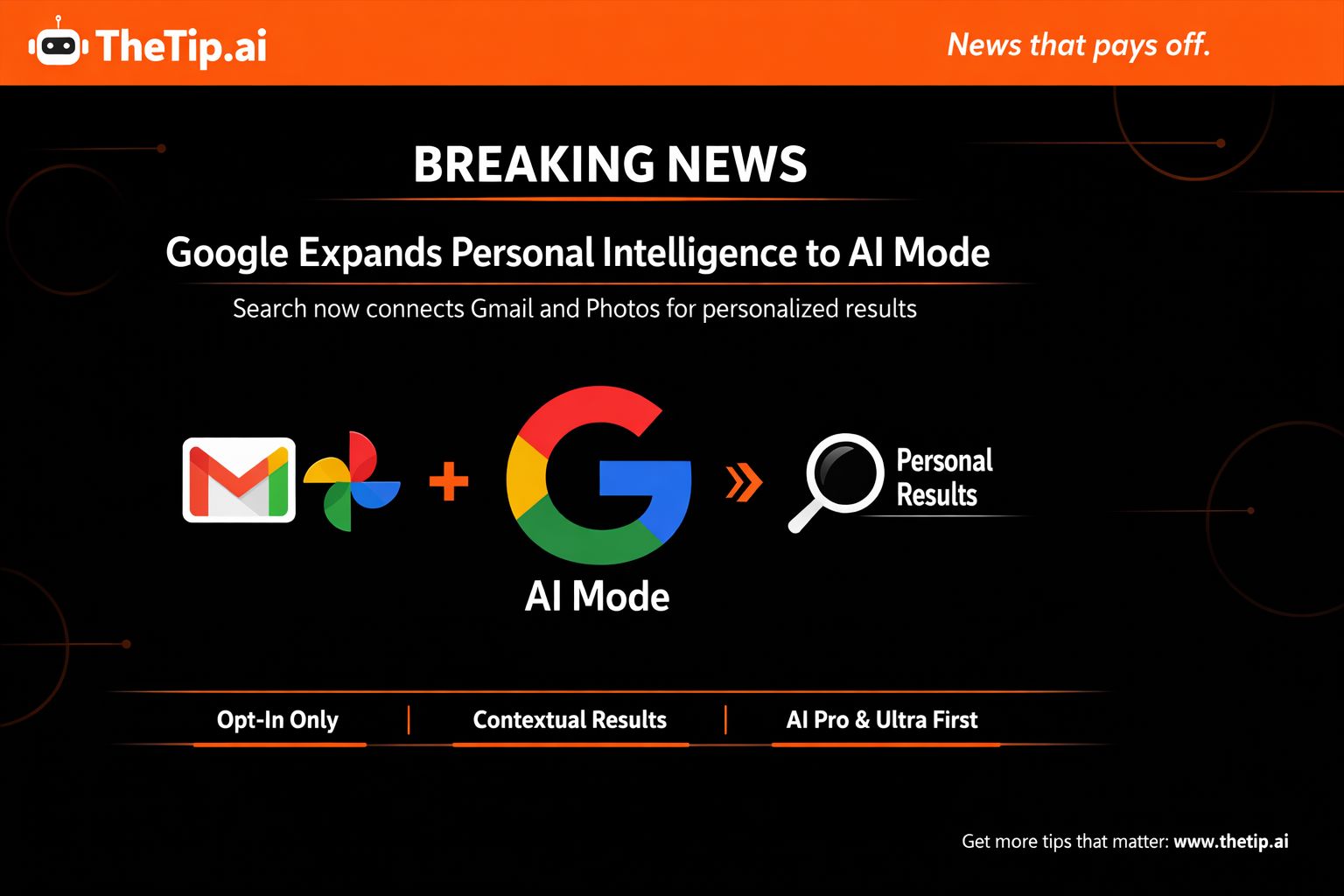
Google Expands Personal Intelligence to AI Mode in Search
Google announced that Personal Intelligence is now available in AI Mode in Google Search.
This connects Gmail and Google Photos to Search responses, making results uniquely tailored to you.
Rolling out this week to Google AI Pro and AI Ultra subscribers in the U.S.
What Changed
Search already accesses the world's information. Now it accesses your information too.
AI Mode can reference your hotel booking in Gmail and travel memories in Google Photos to suggest an itinerary with something for everyone.
Planning a trip? It recalls your ice cream selfies and suggests an old-timey ice cream parlor.
Shopping for a coat? It considers the brands you prefer and checks your flight confirmation to identify destination and timing. You get windproof, versatile coats that fit the weather and your style.
It's like a personal shopper who already knows your itinerary and the vibe you're going for.
How It Works
Connecting apps is strictly opt-in. You choose if and when to connect Gmail and Google Photos to Search.
When enabled, AI Mode uses Gemini 3 to deliver tailored responses based on your context.
Real example from Robby Stein, VP of Product at Google Search:
He was looking for new sneakers. AI Mode noticed a brand he'd just bought and suggested a new style he hadn't seen yet. The recommendation was spot on—he bought them instantly.
The Personal Context Advantage
AI Mode doesn't just match your interests. It fits seamlessly into your life.
You don't constantly explain preferences or existing plans. It selects recommendations just for you from the start.
Fun queries work too: "If my life were a movie, what would the title and genre be?" or "Describe my perfect day."
Privacy Approach
Built with privacy in mind. AI Mode doesn't train directly on your Gmail inbox or Google Photos library.
Training is limited to specific prompts in AI Mode and the model's responses to improve functionality over time.
You control connections. Turn them on or off anytime.
AI Mode references information it used from connected sources so you can verify it.
If a response feels off, correct it on the spot: "Remember, I prefer window seats."
Known Limitations
Google tested extensively but hasn't eliminated mistakes.
You may encounter inaccurate responses or "over-personalization" where the model makes connections between unrelated topics.
AI Mode may struggle with timing or nuance. Relationship changes. Various interests.
Example: Hundreds of photos at a golf course might lead it to assume you love golf. But you don't love golf. You love your son. That's why you're there.
If AI Mode gets this wrong, tell it: "I don't like golf."
Availability
Rolling out over the next few days to Google AI Pro and AI Ultra subscribers in English in the U.S.
Works across web, Android, and iOS with all models in the Gemini model picker.
Later expanding to more countries and the free tier.
Not available for Workspace business, enterprise, or education users yet.
Why This Matters
This is Google's answer to OpenAI's ChatGPT memory and Anthropic's context windows.
Every AI assistant is racing to become personal. To know you. To anticipate needs.
The winner won't be the smartest AI. It'll be the one that integrates deepest into your actual life.
Google has Gmail, Photos, Calendar, Search, Maps. That's a massive data advantage over competitors.
If Personal Intelligence works as promised, AI Mode becomes your operating system for daily tasks.
Not just a search engine you query. An assistant that knows you.
Over to You...
Does giving Google access to your Gmail and Photos feel worth the personalized results?
Tell me what you think.
To privacy in the AI age,
Jeff J. Hunter
Founder, AI Persona Method | TheTip.ai
 | » NEW: Join the AI Money Group « 🚀 Zero to Product Masterclass - Watch us build a sellable AI product LIVE, then do it yourself 📞 Monthly Group Calls - Live training, Q&A, and strategy sessions with Jeff |
Sent to: {{email}} Jeff J Hunter, 3220 W Monte Vista Ave #105, Turlock, Don't want future emails? |
Reply